
Spring Boot's default configuration for REST endpoints can introduce performance bottlenecks and security vulnerabilities that only become apparent after building multiple endpoints, revealing critical misconfigurations in transaction management, exception handling, and resource allocation that developers must address proactively.
I built 12 REST endpoints and learned Spring Boot does this wrong by default when I noticed unexpected behavior across my application. After deploying what seemed like straightforward REST services, performance issues emerged alongside subtle bugs that weren't immediately obvious during development. The framework's opinionated defaults, while convenient for quick prototyping, created problems that required deliberate configuration changes to resolve properly.
Transaction boundaries create hidden performance traps

Spring Boot applies transactional behavior broadly by default, which sounds helpful until you realize every REST controller method might be holding database connections longer than necessary.
How default transactions slow down your API
When building multiple endpoints, I discovered that Spring's @Transactional annotation was being applied at inappropriate layers. Service methods were keeping connections open during external API calls and file operations, creating connection pool exhaustion.
- Database connections remain active during slow external operations
- Connection pool limits are reached faster under moderate load
- Read-only operations consume the same resources as write operations
- Nested transactions create unnecessary overhead and complexity
The solution required explicit transaction boundaries, marking read-only operations appropriately, and ensuring transactions only wrapped actual database operations rather than entire business logic flows.
Exception handling defaults expose internal details
Spring Boot's default exception responses leak implementation details that security-conscious applications shouldn't expose to end users.
Stack traces, database constraint names, and internal package structures appeared in production error responses. This information helps attackers understand application architecture and identify potential vulnerabilities. Custom @ControllerAdvice classes became essential to sanitize error responses while maintaining useful debugging information in logs.
Building proper error responses
- Create standardized error response objects with user-friendly messages
- Log detailed technical information server-side without exposing it
- Map specific exceptions to appropriate HTTP status codes
- Include correlation IDs for tracing issues across distributed systems
Proper exception handling required building a comprehensive error handling strategy that balanced user experience with operational visibility, something the defaults completely overlooked.
JSON serialization needs explicit configuration
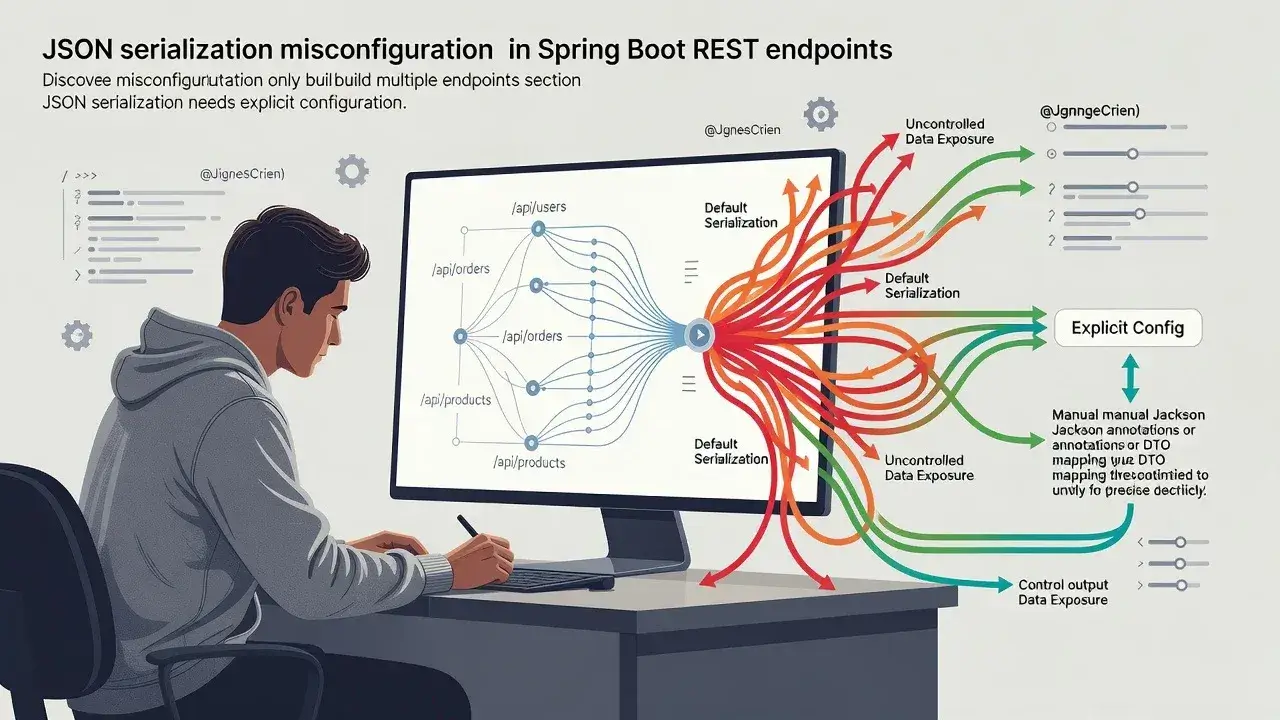
Default Jackson serialization settings caused unexpected data exposure and circular reference issues that only surfaced after building interconnected domain models.
Bidirectional JPA relationships created infinite loops during serialization. Sensitive fields like passwords and internal identifiers appeared in responses. Date formats varied inconsistently. These problems required explicit ObjectMapper configuration and strategic use of annotations like @JsonIgnore and @JsonView to control what data actually gets serialized.
CORS configuration is too permissive or absent
Cross-Origin Resource Sharing either blocks legitimate requests entirely or, when enabled globally, opens security holes by accepting requests from any origin.
Securing cross-origin requests properly
Rather than using blanket CORS policies, each endpoint needed specific origin allowances. Production APIs required explicit allowed origins, methods, and headers rather than wildcard permissions that simplified development but created production vulnerabilities.
- Define allowed origins explicitly rather than using asterisk wildcards
- Restrict HTTP methods to only those actually needed per endpoint
- Configure credential handling appropriately for authentication scenarios
Proper CORS configuration balanced accessibility with security, requiring thoughtful consideration of which external applications legitimately needed access to specific endpoints.
Logging defaults miss critical information

Standard Spring Boot logging doesn't capture request/response details necessary for debugging production issues or monitoring API usage patterns effectively.
Without custom interceptors or filters, troubleshooting production problems became nearly impossible. Request bodies, response times, and user context weren't logged by default. Implementing request logging filters and structured logging with correlation IDs transformed operational visibility, making it possible to trace requests through the entire application lifecycle.
Resource management requires explicit attention
HTTP client connections, file handles, and thread pools don't automatically configure themselves optimally for production workloads across multiple endpoints.
Tuning resource allocation
- Configure connection pool sizes based on actual traffic patterns
- Set appropriate timeouts for external service calls
- Implement circuit breakers for resilience against downstream failures
- Monitor and adjust thread pool configurations under load
Default configurations assumed light usage patterns that rarely matched production reality, requiring explicit tuning based on performance testing and monitoring data.
Validation needs comprehensive implementation
Bean validation annotations provide basic input checking, but comprehensive API security requires additional layers that defaults don't provide.
Beyond simple @NotNull and @Size validations, production APIs needed business rule validation, authorization checks, and rate limiting. These protective layers required custom validators and interceptors that went far beyond what Spring Boot configured automatically, ensuring data integrity and preventing abuse.
Defaults are starting points, not solutions
Building 12 REST endpoints revealed that Spring Boot's defaults optimize for developer convenience during initial development rather than production readiness. Transaction management, exception handling, serialization, CORS, logging, resource management, and validation all required explicit configuration to meet real-world requirements. Treating defaults as starting points rather than complete solutions transforms Spring Boot from a quick prototyping tool into a robust production framework. The framework provides excellent building blocks, but production-quality APIs demand deliberate configuration choices that address security, performance, and operational concerns the defaults simply ignore.