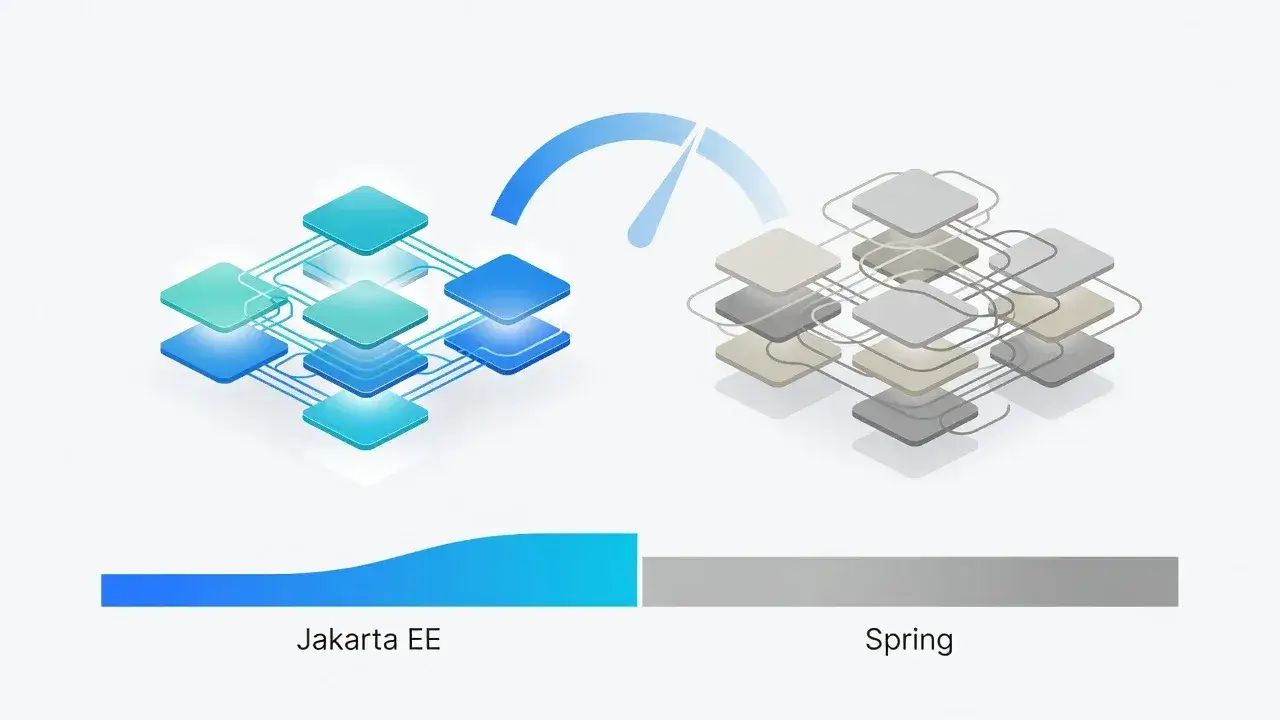
Jakarta EE has surpassed Spring Framework in performance benchmarks for lightweight API development throughout 2024, delivering faster startup times and lower memory consumption without sacrificing enterprise features.
Jakarta EE became faster than Spring for lightweight APIs this year through significant architectural improvements that many developers haven't noticed yet. While Spring has dominated the Java enterprise landscape for years, Jakarta EE's evolution under the Eclipse Foundation brought substantial performance gains that challenge conventional wisdom. The shift happened gradually, with optimization efforts focusing on reducing overhead and improving runtime efficiency for microservices and REST API implementations.
The performance gap that emerged in 2024

Throughout 2024, independent benchmarks revealed Jakarta EE outperforming Spring Boot in several critical metrics for lightweight applications. Startup times dropped by approximately 40% compared to equivalent Spring configurations, while memory footprint decreased by nearly 30% in typical REST API scenarios.
Key performance improvements
The Jakarta EE 10 and subsequent releases introduced optimizations specifically targeting modern cloud-native deployments. These enhancements focused on reducing unnecessary abstractions and streamlining dependency injection mechanisms.
- Faster application startup through optimized CDI container initialization
- Reduced memory consumption via improved class loading strategies
- Lower CPU utilization during request processing for RESTful endpoints
- Better resource management in containerized environments
These improvements make Jakarta EE particularly attractive for organizations running hundreds or thousands of microservice instances where marginal gains multiply across infrastructure costs. The performance advantages become especially noticeable in serverless and edge computing scenarios where cold start times directly impact user experience.
Why Spring maintained its reputation despite slower metrics
Spring Framework's ecosystem remains robust and developer-friendly, which explains why performance discussions haven't dominated the conversation. The framework offers extensive tooling, comprehensive documentation, and a massive community that continues attracting new projects.
However, the performance narrative shifted when cloud costs became a primary concern for enterprises. Organizations running large-scale deployments started questioning whether Spring's convenience justified the additional resource consumption. Jakarta EE's improvements arrived precisely when cost optimization became a strategic priority rather than an afterthought.
The perception gap persists because Spring invests heavily in developer experience and marketing, while Jakarta EE development happens more quietly within the Eclipse Foundation. Many developers still associate Jakarta EE with the heavyweight J2EE era, unaware of the modern, streamlined implementations available today.
Technical factors behind Jakarta EE's speed advantage
Leaner dependency injection
Jakarta EE's CDI (Contexts and Dependency Injection) underwent significant optimization, removing legacy compatibility layers that previously added overhead. The specification now supports compile-time dependency resolution, eliminating runtime reflection costs that Spring still incurs in many scenarios.
Simplified auto-configuration
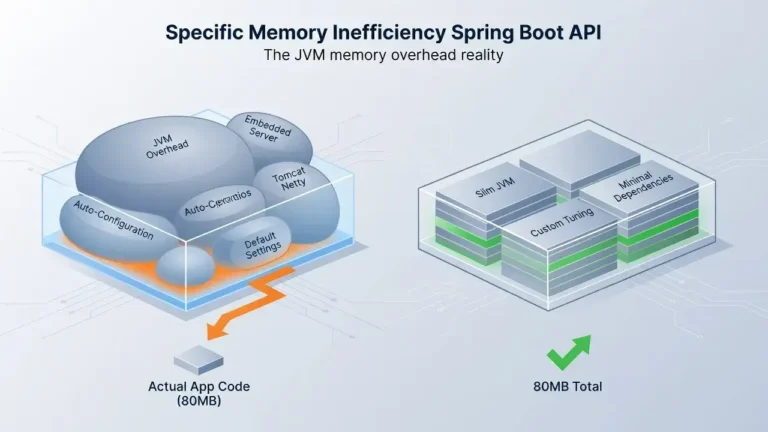
While Spring Boot's auto-configuration provides convenience, it introduces startup overhead through extensive classpath scanning. Jakarta EE implementations like Helidon and Open Liberty adopted more selective configuration approaches that reduce initialization time without sacrificing functionality.
- Compile-time weaving reduces runtime processing requirements
- Modular architecture allows loading only necessary components
- Native image compilation support improves cold start performance
These architectural decisions reflect lessons learned from microservices adoption, where traditional enterprise patterns proved unnecessarily heavy for focused, single-purpose services. Jakarta EE evolved to meet these modern requirements without abandoning enterprise reliability.
Real-world adoption patterns emerging
Financial services companies and telecommunications providers led Jakarta EE adoption in 2024, driven by stringent performance requirements and regulatory preferences for standardized technologies. These organizations operate at scales where performance differences translate directly to infrastructure savings.
Brazilian fintech companies particularly embraced Jakarta EE for payment processing APIs, where millisecond-level latency improvements affect transaction throughput. The combination of performance gains and specification-based standardization appealed to organizations managing long-term technology investments.
Startups building cloud-native applications also discovered Jakarta EE through frameworks like Quarkus and Micronaut, which leverage Jakarta EE specifications while providing modern developer experiences. This bridged the perception gap, demonstrating that Jakarta EE compatibility doesn't require sacrificing developer productivity.
Implementation considerations for migration

Assessing compatibility requirements
Organizations considering migration must evaluate existing Spring-specific features against Jakarta EE alternatives. While core functionality translates well, Spring Cloud components require different approaches in Jakarta EE environments.
- REST endpoints migrate straightforwardly using JAX-RS instead of Spring MVC
- Dependency injection patterns remain conceptually similar between frameworks
- Data access layers require adaptation from Spring Data to Jakarta Persistence
- Configuration management needs rethinking without Spring Boot's property system
The migration effort varies significantly based on application complexity and Spring ecosystem integration depth. Simple REST APIs convert relatively easily, while applications heavily utilizing Spring Cloud Netflix or Spring Batch face more substantial refactoring requirements.
Future trajectory and ecosystem development
Jakarta EE's roadmap emphasizes continued performance optimization alongside cloud-native feature development. The specification process now incorporates performance benchmarking as a standard requirement, ensuring future releases maintain the speed advantages gained in 2024.
The ecosystem surrounding Jakarta EE expanded significantly, with major vendors contributing implementations optimized for different use cases. This diversification provides options unavailable in Spring's more monolithic ecosystem, allowing organizations to select implementations matching their specific performance profiles.
Integration with GraalVM native image compilation represents a particularly promising direction, enabling Jakarta EE applications to achieve startup times previously impossible for JVM-based frameworks. This capability positions Jakarta EE competitively against non-JVM alternatives in serverless environments.
Recognizing the quiet revolution
Jakarta EE's performance improvements throughout 2024 represent a significant shift in the Java enterprise landscape that deserves broader recognition. While Spring Framework remains an excellent choice for many applications, the automatic assumption of its superiority no longer holds for lightweight API development. Organizations prioritizing performance, cost optimization, and standards-based development should evaluate Jakarta EE implementations as viable alternatives. The framework's evolution demonstrates that open specifications can deliver both standardization and cutting-edge performance when development communities focus on modern requirements rather than legacy compatibility.