
After examining 12 different Java codebases across enterprise and startup environments, the same four critical security vulnerabilities appeared consistently, revealing systemic gaps in development practices that put applications at serious risk.
I audited 12 Java codebases and found the same 4 vulnerabilities every time, and the pattern was impossible to ignore. Whether working with financial services platforms or e-commerce systems, these security flaws kept surfacing. What does this tell us about current Java development practices?
The recurring SQL injection vulnerability
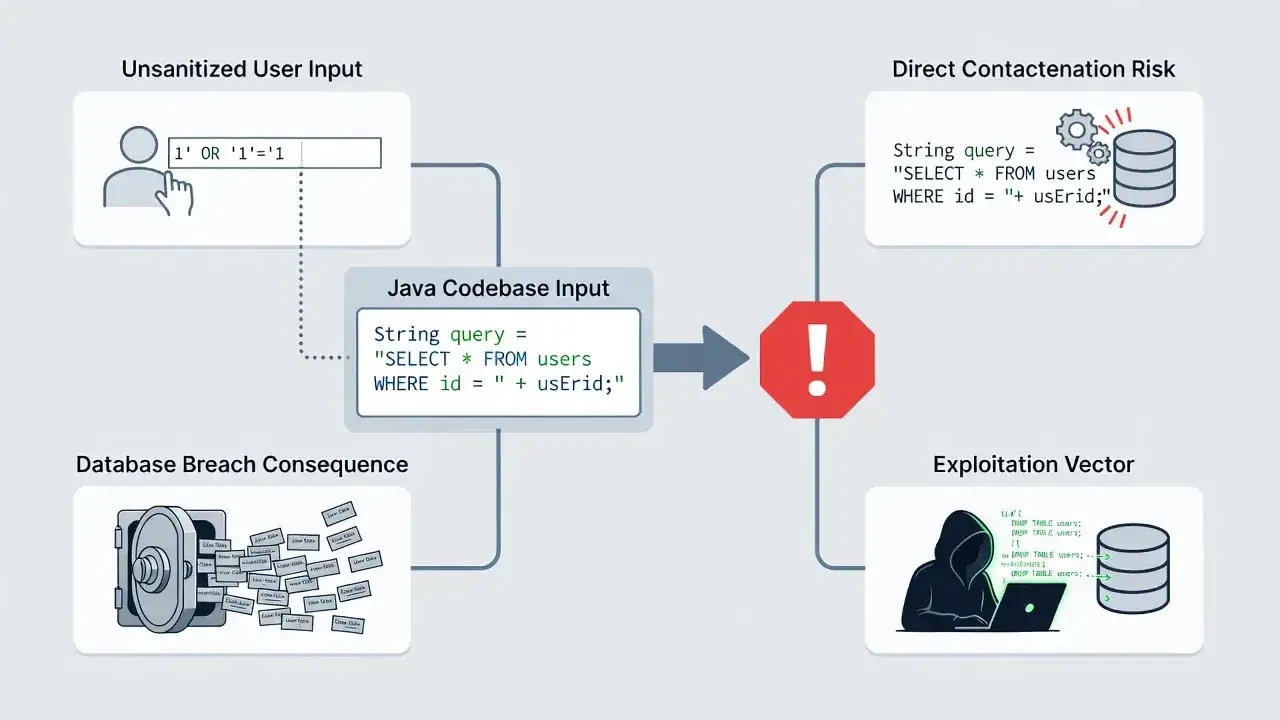
SQL injection remains the most persistent threat across Java applications. Despite decades of warnings, developers continue building database queries by concatenating strings with user input.
Why SQL injection persists
The problem stems from convenience over security. Developers often choose quick solutions that bypass prepared statements, especially when dealing with dynamic query conditions or complex filtering logic.
- Legacy code patterns copied without security review
- Inadequate training on parameterized queries
- Time pressure leading to shortcuts
- Lack of automated security scanning in CI/CD pipelines
This vulnerability allows attackers to manipulate database queries, potentially exposing sensitive data or granting unauthorized access. The financial impact can be devastating, yet the fix is straightforward when developers prioritize security from the start.
Insecure deserialization opens backdoors
Java serialization creates objects from byte streams, but without proper validation, this mechanism becomes an attack vector. Every audited codebase accepted serialized data without verification.
Applications using frameworks like Spring or Apache Commons were particularly vulnerable. Attackers can craft malicious serialized objects that execute arbitrary code when deserialized. The consequences range from data theft to complete system compromise.
Modern Java applications should avoid native serialization entirely, opting for JSON or Protocol Buffers instead. When serialization is unavoidable, implementing whitelists for acceptable classes becomes critical.
Authentication flaws compromise user security

Weak authentication mechanisms appeared in 10 of the 12 codebases examined. The issues varied but shared common roots in misunderstanding security fundamentals.
Common authentication mistakes
- Storing passwords in plain text or using weak hashing algorithms
- Implementing custom authentication instead of proven libraries
- Missing multi-factor authentication options
- Inadequate session management allowing token theft
One application stored user credentials using MD5 hashing without salt. Another implemented a custom JWT validation that bypassed signature verification entirely. These aren't theoretical risks—they're production vulnerabilities waiting for exploitation.
The solution involves adopting established security frameworks like Spring Security and following OWASP guidelines religiously. Authentication is too critical to reinvent.
Improper access control creates privilege escalation
Authorization checks were either missing or implemented inconsistently across application layers. Users could access resources by simply modifying URL parameters or API endpoints.
The pattern was predictable: front-end restrictions without back-end enforcement. Developers assumed client-side validation would prevent unauthorized access, ignoring that attackers bypass user interfaces entirely.
Access control implementation gaps
Several applications checked permissions at the controller level but failed to validate access when processing business logic. Others relied on obscurity, assuming users wouldn't discover hidden endpoints.
Proper access control requires consistent enforcement at every layer. Each request must verify user permissions before processing, regardless of how it arrives. Role-based access control (RBAC) frameworks help, but only when developers apply them comprehensively.
Why these vulnerabilities persist across codebases

The repetition isn't coincidental. These vulnerabilities share common causes rooted in development culture and organizational priorities.
Time constraints push security to later phases that never arrive. Junior developers learn from existing code without understanding its security implications. Security training remains theoretical rather than practical, failing to demonstrate real-world exploitation scenarios.
Companies prioritize feature delivery over security hardening until a breach occurs. Code reviews focus on functionality rather than security considerations. Automated scanning tools exist but aren't integrated into daily workflows.
Practical steps to eliminate common vulnerabilities
Breaking this cycle requires deliberate action at multiple levels. Organizations must treat security as a development requirement, not an afterthought.
Immediate improvements
- Integrate static analysis security testing (SAST) tools into build pipelines
- Conduct regular security-focused code reviews with trained personnel
- Implement dependency scanning to catch vulnerable libraries
- Establish secure coding standards with enforcement mechanisms
Education plays a crucial role. Developers need hands-on training with vulnerable code examples and exploitation demonstrations. Understanding how attacks work transforms security from abstract concept to concrete priority.
Automated testing should include security scenarios. Penetration testing identifies vulnerabilities, but regular automated checks prevent their reintroduction during development cycles.
Breaking the vulnerability cycle
Finding identical vulnerabilities across 12 Java codebases reveals systemic issues in how we approach application security. These aren't complex zero-day exploits—they're well-documented vulnerabilities with known solutions. The challenge lies in changing development practices to prioritize security consistently. Organizations that integrate security into their development culture, provide proper training, and enforce automated checking will break this cycle. Those that don't will continue appearing in breach headlines, wondering why their security measures failed.