
Enterprise Java teams frequently implement input validation at the wrong architectural layer, treating REST API validation as a secondary concern rather than a fundamental security and data integrity mechanism that should operate at the API boundary before data enters business logic.
Input validation in REST APIs remains one of the most misunderstood aspects of enterprise Java development. Teams often scatter validation logic across multiple layers, creating maintenance nightmares and security vulnerabilities. The confusion stems from conflicting advice about where validation belongs—should it happen in controllers, services, or domain models? This architectural uncertainty leads to inconsistent implementations that fail to protect applications effectively.
Validating at the wrong architectural layer
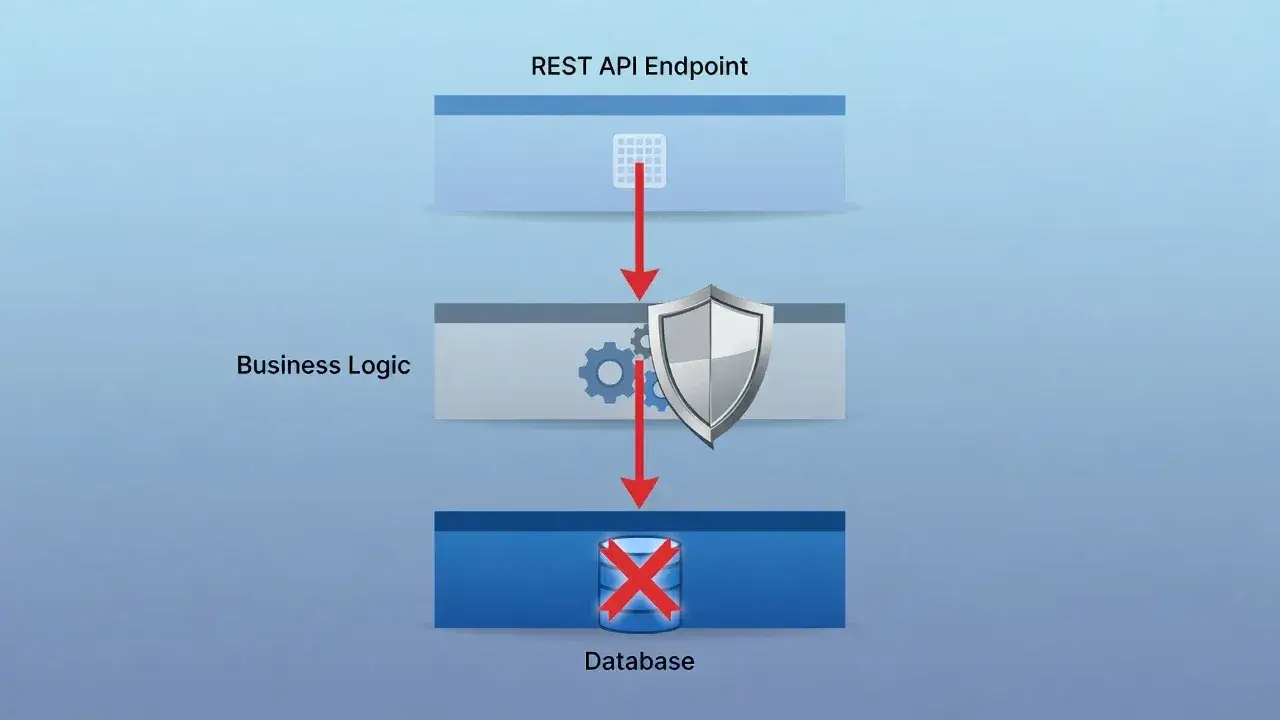
Many Java teams push validation deep into service or domain layers, missing the critical opportunity to reject invalid data at the API boundary. This approach allows malformed requests to penetrate multiple application layers before detection.
The controller-level validation advantage
Implementing validation at the controller level using Bean Validation annotations provides immediate feedback to API consumers. When combined with Spring's @Valid annotation, this approach automatically returns standardized error responses without cluttering business logic.
- Reduces unnecessary processing of invalid requests
- Provides consistent error response formats across endpoints
- Separates technical validation from business rule enforcement
- Improves API documentation through constraint annotations
Controller-level validation acts as the first line of defense, ensuring only structurally valid data reaches your business logic while keeping your service layer focused on domain concerns.
Confusing validation with business rules
A common mistake involves mixing syntactic validation with semantic business rules. Teams often implement complex business logic within validation constraints, creating tight coupling and reducing reusability.
Technical validation should verify data format, type, and structure—ensuring an email looks like an email or a number falls within acceptable ranges. Business rules, however, belong in the service layer where they can access repositories and evaluate domain-specific conditions.
Distinguishing the two concerns
- Technical validation: format, length, pattern matching, required fields
- Business rules: uniqueness checks, state transitions, authorization decisions
- Cross-field validation: relationships between multiple input fields
This separation ensures your validation annotations remain portable and your business logic testable without HTTP context dependencies.
Overrelying on Bean Validation alone

While Bean Validation provides excellent declarative validation, enterprise teams often neglect custom validation needs. Not every validation scenario fits neatly into standard annotations.
Complex scenarios require custom validators that can access Spring-managed beans, perform database lookups, or validate relationships between fields. Teams that avoid creating custom validators end up with convoluted workarounds or validation gaps.
When to build custom validators
Create custom constraint annotations when you need context-aware validation, cross-field checks, or integration with external systems. Spring makes this straightforward through ConstraintValidator implementations that support dependency injection.
Custom validators maintain the declarative validation style while handling enterprise-specific requirements that standard annotations cannot address.
Ignoring content type validation
Java teams frequently forget to validate the Content-Type header, accepting any media type and attempting to deserialize whatever arrives. This creates security vulnerabilities and confusing error messages.
Explicitly declaring consumed media types using @Consumes annotations ensures your endpoints reject unexpected content types before deserialization attempts. This prevents attacks that exploit parser vulnerabilities and provides clear API contracts.
- Prevents JSON injection attacks through alternate parsers
- Reduces server resource consumption on invalid requests
- Improves API documentation clarity
Failing to validate collections properly

When REST endpoints accept lists or arrays, teams often validate the collection itself but forget to validate individual elements. A request with a valid array structure containing invalid objects slips through.
The solution requires cascading validation using @Valid on collection elements. Without this, your validation framework checks the collection exists but ignores element constraints.
Proper collection validation syntax
Annotate collection parameters with both size constraints and element validation. This dual-layer approach ensures both collection boundaries and element integrity meet your requirements.
Collection validation becomes particularly critical in batch operations where a single invalid element could corrupt entire transaction batches.
Neglecting error response standardization
Different validation failures often produce inconsistent error response formats across an API. Some endpoints return field-level details while others provide generic messages, frustrating API consumers.
Implementing a global @ControllerAdvice exception handler that processes MethodArgumentNotValidException creates uniform error responses. This handler should extract field errors, constraint violations, and validation messages into a consistent structure.
- Include field names, rejected values, and violation messages
- Provide machine-readable error codes alongside human messages
- Maintain consistent HTTP status codes for validation failures
Skipping security-focused validation
Beyond format checking, input validation serves as a critical security control. Teams often overlook validation patterns that prevent injection attacks, path traversal, and other exploits.
Every string input accepting file paths, SQL fragments, or system commands needs strict whitelist validation. Regular expressions and custom validators should enforce allowed character sets rather than attempting to blacklist dangerous patterns.
Security-focused validation assumes all input is hostile and requires explicit proof of safety rather than absence of obvious threats.
Building robust API validation
Effective input validation in enterprise Java REST APIs requires architectural clarity, separating technical validation from business rules while maintaining security consciousness. By validating at the API boundary, standardizing error responses, and treating validation as a first-class architectural concern, teams build more secure and maintainable systems. The key lies in recognizing validation not as boilerplate code but as a critical component of API design that deserves careful consideration and consistent implementation across your application.