
Azure Spring Apps offers a managed platform-as-a-service (PaaS) solution for Java applications, while plain containers provide greater flexibility and control over infrastructure, with the choice depending on your team's expertise, operational requirements, and long-term maintenance strategy.
Azure Spring Apps versus plain containers for Java workloads represents a critical decision point for development teams deploying modern Java applications. Choosing between a managed service that handles infrastructure concerns and container-based deployments that offer complete control affects everything from development velocity to operational costs. Understanding these trade-offs helps teams make informed decisions aligned with their technical capabilities and business objectives.
Understanding Azure Spring Apps architecture
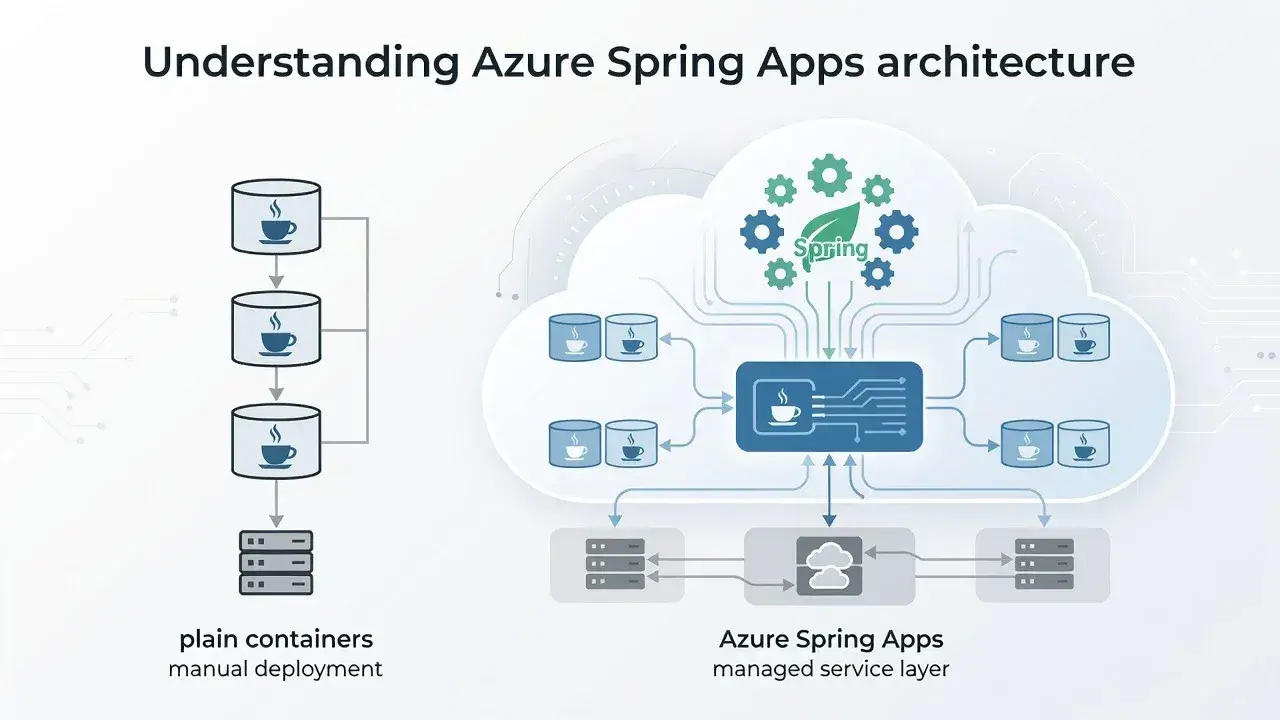
Azure Spring Apps delivers a fully managed environment specifically designed for Spring Boot applications. Microsoft handles the underlying infrastructure, including OS patching, scaling mechanisms, and service discovery.
Built-in Spring Cloud features
The platform integrates Spring Cloud components natively, reducing configuration overhead. Teams get access to service registry, config server, and distributed tracing without manual setup.
- Automated service discovery through Eureka integration
- Centralized configuration management with Spring Cloud Config
- Built-in application performance monitoring and diagnostics
- Native integration with Azure services like Key Vault and Application Insights
This managed approach accelerates deployment cycles by eliminating infrastructure management tasks. Developers focus on application code while Azure handles operational complexity, making it particularly attractive for teams with limited DevOps resources.
Plain container deployments explained
Container-based approaches using Docker and Kubernetes offer maximum flexibility for Java workloads. Teams package applications with all dependencies, ensuring consistency across environments.
Running containers on Azure Kubernetes Service (AKS) or similar platforms gives complete control over runtime configuration, networking policies, and resource allocation. This flexibility comes with increased operational responsibility.
Container orchestration considerations
- Full control over Kubernetes cluster configuration and versions
- Ability to run multiple application types beyond Spring Boot
- Custom networking and security policy implementation
- Direct access to container runtime for debugging and optimization
Organizations with existing container expertise often prefer this approach. The learning curve is steeper, but the payoff includes portability across cloud providers and on-premises infrastructure.
Cost comparison and pricing models
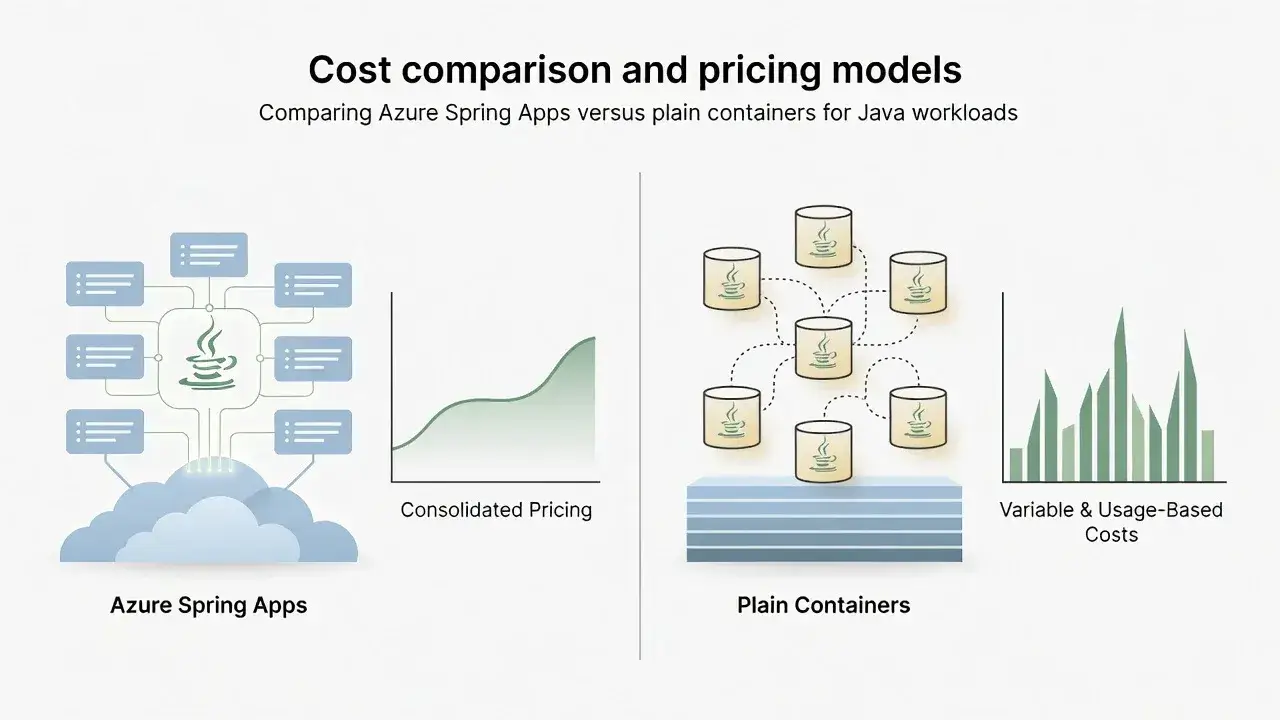
Azure Spring Apps charges based on vCore hours and application instances. The managed service includes infrastructure costs, support, and integrated monitoring tools in the pricing structure.
Plain container deployments on AKS involve separate charges for compute resources, storage, networking, and any additional monitoring solutions. Initial costs may appear lower, but operational overhead adds hidden expenses.
Total cost of ownership factors
Beyond direct infrastructure costs, consider personnel time for maintenance, security updates, and troubleshooting. Managed services reduce these operational burdens significantly.
- Azure Spring Apps includes automatic patching and updates
- Container deployments require dedicated DevOps resources
- Scaling costs differ based on application architecture
For smaller teams, managed services often provide better value despite higher per-instance costs. Larger organizations with established container operations may achieve economies of scale with plain containers.
Development experience and productivity
Azure Spring Apps streamlines the development workflow with IDE plugins and CLI tools specifically designed for Spring applications. Developers deploy directly from their development environment without complex pipeline configurations.
Container-based workflows require additional steps: building images, pushing to registries, and managing Kubernetes manifests. These steps add complexity but provide greater deployment flexibility.
CI/CD pipeline integration
Both approaches integrate with Azure DevOps, GitHub Actions, and Jenkins. Azure Spring Apps offers simplified pipelines with fewer configuration steps, while container deployments enable more granular control over build and deployment stages.
Teams already using containerized workflows for other applications may find consistency valuable. New projects without existing container infrastructure benefit from Azure Spring Apps' reduced setup time.
Operational management and monitoring

Azure Spring Apps provides integrated application monitoring through Azure Monitor and Application Insights. Metrics, logs, and distributed traces are available without additional configuration.
Container deployments require separate monitoring solutions. Teams typically implement Prometheus, Grafana, and centralized logging systems, adding configuration and maintenance overhead.
Scaling and performance optimization
- Azure Spring Apps offers automatic scaling based on CPU and memory metrics
- Kubernetes provides horizontal pod autoscaling with custom metrics
- Container deployments enable fine-grained resource allocation
- Managed services handle capacity planning automatically
Performance tuning in containers requires deeper infrastructure knowledge but enables optimizations impossible in managed environments. The trade-off between convenience and control defines the operational experience.
Security and compliance considerations
Azure Spring Apps implements security best practices by default, including network isolation, managed identities, and automatic security patches. Compliance certifications transfer from the platform to applications.
Container deployments require manual security configuration. Teams control network policies, pod security standards, and vulnerability scanning processes. This control enables custom security implementations but demands specialized expertise.
Identity and access management
Both approaches integrate with Azure Active Directory for authentication. Azure Spring Apps simplifies managed identity configuration for accessing Azure resources, while container deployments require manual pod identity setup.
Organizations with strict compliance requirements may prefer container control for audit trails and custom security policies. Standard security needs are well-served by managed service defaults.
Migration and portability concerns
Azure Spring Apps creates platform dependency, making future migrations more complex. Applications become tightly coupled to Azure-specific features and configurations.
Container-based deployments offer superior portability. The same container images run on different cloud providers or on-premises infrastructure with minimal modifications.
Vendor lock-in assessment
- Containers provide multi-cloud flexibility
- Azure Spring Apps optimizes for Azure ecosystem integration
- Migration costs vary based on application architecture
Long-term strategic considerations should weigh vendor lock-in risks against immediate productivity benefits. Organizations committed to Azure may prioritize integration over portability.
Making the right choice for your workload
The decision between Azure Spring Apps and plain containers depends on team capabilities, application requirements, and organizational priorities. Managed services excel for teams prioritizing speed and simplicity, while containers suit organizations with existing orchestration expertise.
Consider starting with Azure Spring Apps for rapid deployment and migrating to containers as operational maturity grows. This phased approach balances immediate productivity with long-term flexibility, allowing teams to evolve their infrastructure strategy as needs change.