Java record classes provide immutable data carriers that eliminate boilerplate code in DTOs, offering built-in implementations of constructors, getters, equals, hashCode, and toString methods while ensuring thread-safety and cleaner code architecture.
Java record classes changed how I write request DTOs in every project now because they solve one of the most tedious aspects of backend development: writing repetitive boilerplate code. Before records arrived in Java 14 as a preview feature and became standard in Java 16, creating DTOs meant writing dozens of lines for simple data containers. Now, a single line can replace what used to take an entire class file.
Why traditional DTO classes felt like unnecessary work

Creating DTOs the old way meant writing constructors, getters, setters, equals, hashCode, and toString methods manually. Even with IDE assistance or Lombok annotations, the code remained verbose and harder to maintain.
A typical request DTO for user registration might span 50-60 lines just to hold three or four fields. This approach created several problems:
- Maintenance overhead when adding or removing fields
- Potential bugs in manually written equals and hashCode methods
- Inconsistent implementations across different DTOs
- Reduced code readability due to excessive boilerplate
The shift to records eliminated these pain points by providing a declarative syntax that focuses on what data the DTO carries rather than how it implements standard methods.
How records simplify DTO declaration
A record declaration condenses everything into a single, readable line. Instead of writing a full class with all the standard methods, you declare the data components directly in the record header.
Basic record syntax for request DTOs
The syntax `public record UserRegistrationRequest(String email, String password, String name) {}` creates a complete DTO with all necessary methods. The compiler automatically generates a canonical constructor, accessor methods for each component, and proper implementations of equals, hashCode, and toString.
This approach reduces cognitive load when reading code. You immediately see what data the DTO carries without scrolling through method implementations. The immutability guarantee also prevents accidental modifications after object creation.
Immutability benefits in request handling

Records are inherently immutable, which aligns perfectly with how request DTOs should behave. Once you receive and validate a request, its data shouldn't change during processing.
This immutability provides thread-safety without additional synchronization code. When multiple threads process requests concurrently, you don't worry about one thread modifying data another thread is reading. The guarantee comes built-in.
- Thread-safe by default without synchronized blocks
- Prevents accidental state mutations in service layers
- Makes code easier to reason about and debug
The immutability also encourages better architectural patterns. When you can't modify a DTO, you naturally separate concerns between data transfer and business logic transformation.
Validation integration with records
Bean Validation annotations work seamlessly with record components. You can add constraints directly to the record declaration, making validation rules immediately visible.
Adding validation constraints
Placing annotations like `@NotBlank`, `@Email`, or `@Size` on record components creates self-documenting DTOs. The validation requirements become part of the data structure definition rather than hidden in separate configuration files.
Custom validation logic fits into compact constructors, which execute before the canonical constructor. This feature lets you add cross-field validation or business rule checks without compromising the record's simplicity.
Serialization and deserialization advantages
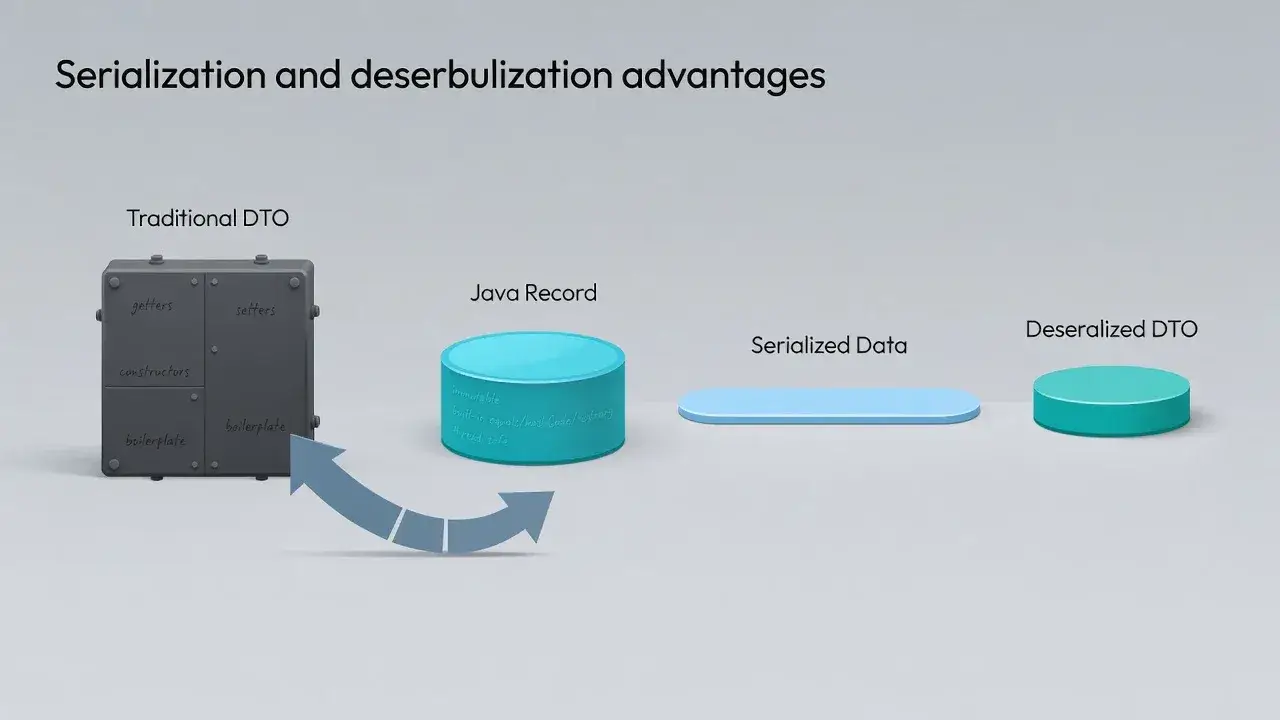
Modern frameworks like Jackson and Spring handle records naturally. The canonical constructor provides a clear contract for deserialization, while component accessors enable serialization without configuration.
JSON mapping works out of the box because records provide getter methods automatically. The naming convention matches JSON property names by default, reducing the need for custom annotations.
Records also play well with OpenAPI documentation generation. Tools can introspect record components to automatically generate accurate API specifications without manual schema definitions.
Pattern matching and records together
Java's pattern matching features combine powerfully with records. You can destructure record components directly in switch expressions or instanceof checks, making request processing code more concise.
- Extract multiple fields in a single pattern match
- Reduce null checking boilerplate
- Create more expressive conditional logic
This combination shines when handling different request types in a unified way. Pattern matching on sealed hierarchies of record types creates type-safe request routing without reflection or instanceof chains.
Migration strategy from traditional DTOs
Converting existing DTOs to records doesn't require a complete rewrite. Start with new request DTOs and gradually migrate existing ones during regular maintenance.
Identifying good candidates for conversion
Simple DTOs with only fields and standard methods convert easily. DTOs with custom business logic or mutable state need more consideration before migration.
Test coverage helps ensure behavioral equivalence after conversion. The automatic equals and hashCode implementations might differ slightly from hand-written versions, affecting test assertions or collection behavior.
Matching Integration
Java record classes transformed DTO development from a tedious necessity into a straightforward declaration. The combination of reduced boilerplate, built-in immutability, and excellent framework support makes records the natural choice for request DTOs in modern Java projects. The readability improvements alone justify adoption, while the safety guarantees and pattern matching integration provide additional long-term benefits that compound across large codebases.