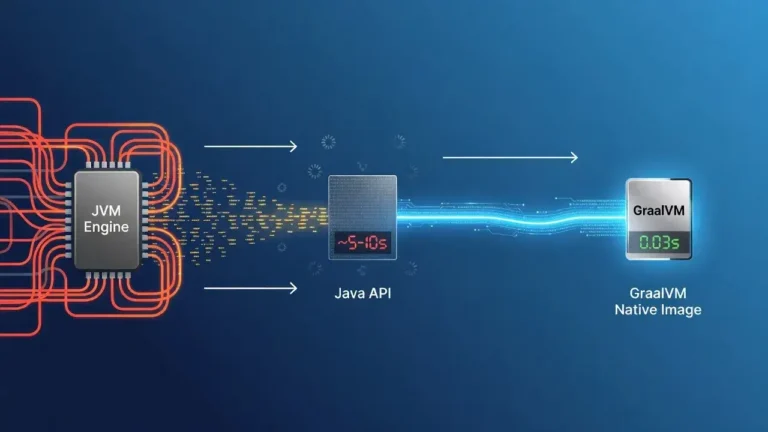
Building a reactive web app in Java combines non-blocking architectures with established frameworks like Spring WebFlux and Project Reactor, enabling developers to handle high-concurrency scenarios efficiently while maintaining code clarity through structured patterns and gradual adoption strategies.
Building a reactive web app in Java without losing your mind to complexity starts with understanding that reactive programming isn't about rewriting everything from scratch. Modern Java frameworks provide practical abstractions that let you adopt reactive patterns incrementally, focusing on specific bottlenecks rather than transforming your entire codebase overnight. This approach keeps your sanity intact while delivering real performance benefits.
Why reactive programming makes sense for Java developers

Traditional blocking I/O models tie up threads while waiting for database queries or external API calls. When you scale to thousands of concurrent users, this approach becomes expensive and inefficient.
The resource efficiency advantage
Reactive systems use event-driven architectures that free up threads during wait times. A single thread can handle multiple requests simultaneously, dramatically reducing memory consumption and infrastructure costs.
- Non-blocking operations release threads back to the pool immediately
- Backpressure mechanisms prevent system overload automatically
- Asynchronous processing improves response times for I/O-bound tasks
- Lower server requirements translate to reduced cloud hosting expenses
The shift from imperative to reactive thinking requires adjusting your mental model, but the frameworks available today smooth out most of the learning curve through intuitive APIs and comprehensive documentation.
Choosing the right reactive framework for your project
Spring WebFlux dominates the Java reactive landscape, offering seamless integration with the Spring ecosystem. It supports both annotation-based and functional programming styles, letting teams choose what feels most natural.
Project Reactor serves as the foundation, providing the Mono and Flux types that represent asynchronous sequences. Mono handles single results while Flux manages streams of multiple items. These abstractions hide the complexity of thread management and error handling.
Vert.x presents an alternative for teams preferring a polyglot toolkit with excellent performance characteristics. It excels in microservices architectures where you need lightweight, fast components that communicate through event buses.
Starting small with reactive endpoints

You don't need to convert your entire application at once. Begin by identifying specific endpoints that handle high traffic or perform multiple I/O operations.
Practical first steps
- Replace blocking database calls with reactive repository methods
- Convert REST clients to WebClient for non-blocking HTTP requests
- Implement reactive controllers for read-heavy operations first
- Keep write operations blocking initially to reduce complexity
This incremental strategy lets your team build confidence and expertise gradually. You'll learn reactive patterns through real implementation rather than theoretical exercises, making the knowledge stick better.
Managing data persistence reactively
R2DBC brings reactive principles to relational databases, providing non-blocking drivers for PostgreSQL, MySQL, and other popular systems. Spring Data R2DBC offers familiar repository abstractions that feel similar to traditional JPA.
For NoSQL solutions, MongoDB and Redis already provide mature reactive drivers. These integrate smoothly with Spring Data, requiring minimal code changes when migrating from blocking implementations.
Transaction management becomes trickier in reactive contexts. You'll need to embrace declarative transactions through annotations or explicitly manage transaction boundaries using operators, but the frameworks handle most edge cases automatically.
Handling errors without losing control

Error handling in reactive streams differs from traditional try-catch blocks. Operators like onErrorResume, onErrorReturn, and retry give you fine-grained control over failure scenarios.
Common error management patterns
Circuit breakers prevent cascading failures by stopping requests to failing services temporarily. Resilience4j integrates perfectly with reactive streams, providing configurable fallback mechanisms.
- Use timeout operators to prevent indefinite waiting
- Implement retry logic with exponential backoff for transient failures
- Log errors without breaking the reactive chain using doOnError
These patterns protect your application from unpredictable external dependencies while maintaining responsiveness under stress conditions.
Testing reactive code effectively
StepVerifier from Project Reactor simplifies testing asynchronous flows. It lets you verify emissions, timing, and error conditions without dealing with threading complexity directly.
Mock reactive dependencies using Mockito or WebTestClient for integration tests. These tools understand reactive types natively, making assertions straightforward and readable.
Focus on testing the happy path first, then systematically add tests for error scenarios, backpressure handling, and timeout conditions. This methodical approach builds confidence in your reactive implementation.
Avoiding common reactive pitfalls
Blocking calls inside reactive chains defeat the entire purpose. Watch for hidden blocking operations in third-party libraries or legacy code integrations.
Subscribe multiple times to the same publisher creates duplicate work. Cache results when appropriate using operators like cache() or share() to avoid redundant processing.
Forgetting to subscribe means nothing happens. Reactive streams are lazy by design, executing only when someone subscribes to the result. This behavior confuses developers coming from imperative backgrounds.
Reactive Java within reach
Building reactive web applications in Java doesn't require mastering every concept upfront. Start with high-impact endpoints, leverage mature frameworks like Spring WebFlux, and expand gradually as your team gains experience. The performance benefits and resource efficiency make the learning investment worthwhile, especially for applications facing growing concurrency demands.