
Java 23 introduces string templates as a preview feature that fundamentally changes how developers handle dynamic content in web controllers, eliminating verbose concatenation and reducing injection vulnerabilities through native language support for safe string interpolation.
Java 23 brought one feature that changes how we write web controllers forever, and it's not just another syntactic sugar addition. String templates represent a paradigm shift in how we construct dynamic responses, validate user input, and maintain code readability in controller layers. This feature addresses decades of pain points that developers faced when building REST APIs and web endpoints.
What makes string templates revolutionary for controllers

Traditional string concatenation in Java web controllers has always been clunky and error-prone. Developers constantly juggled StringBuilder objects, String.format() calls, and manual escaping to generate JSON responses or HTML content.
String templates introduce a native mechanism that feels natural and reads like the output you're trying to create. The syntax uses the STR processor for basic interpolation, allowing expressions directly within strings using {expression} notation.
- Direct variable embedding without concatenation operators
- Expression evaluation within template boundaries
- Compile-time validation of template structure
- Reduced boilerplate code in endpoint methods
This approach transforms controller code from verbose construction logic into declarative output definitions. The compiler understands the template structure, catching errors before runtime that would previously surface only during testing or production.
Security improvements in request handling
Web controllers constantly deal with user input that needs sanitization before inclusion in responses. String templates provide built-in protection against common injection attacks through their processor architecture.
Custom processors for safe interpolation
Developers can create specialized template processors that automatically escape HTML entities, sanitize SQL fragments, or validate JSON structure. The RAW processor gives access to unprocessed fragments when needed for advanced scenarios.
This architectural decision moves security concerns from runtime string manipulation to compile-time template processing. Controllers become inherently safer because the language itself enforces proper handling of dynamic content rather than relying on developer discipline.
Preventing SQL injection in data layers
When controllers construct database queries, string templates with custom processors ensure parameters are properly escaped. The type system guarantees that only validated data reaches the database layer.
- Automatic parameter binding through template analysis
- Type-safe query construction without ORM overhead
- Clear separation between query structure and data
Security vulnerabilities decrease significantly when the language prevents dangerous patterns by design rather than documentation.
JSON response generation becomes intuitive

REST controllers spend most of their time constructing JSON responses. Before string templates, this meant either using heavy serialization libraries or manually building JSON strings with careful attention to syntax.
String templates allow developers to write JSON structure directly in controller methods. The template reads like the actual JSON output, making code reviews and maintenance dramatically easier. Complex nested objects become readable without sacrificing performance.
The JSON processor validates structure at compile time, catching missing commas, unclosed brackets, and type mismatches before deployment. This eliminates entire categories of runtime errors that plague traditional approaches.
Performance characteristics in high-traffic scenarios
String templates compile to efficient bytecode that often outperforms traditional concatenation approaches. The JVM optimizes template processing during JIT compilation, recognizing common patterns and eliminating intermediate object creation.
Memory allocation patterns
Traditional string building creates multiple intermediate String objects that pressure garbage collection. Templates generate minimal temporary objects because the processor can calculate final size and allocate once.
- Reduced GC pressure in controller hot paths
- Predictable memory footprint for response generation
- Better cache locality for template-heavy code
Benchmarks show 20-30% reduction in allocation rates for typical REST endpoint implementations, translating to higher throughput under load.
Migration strategies for existing codebases
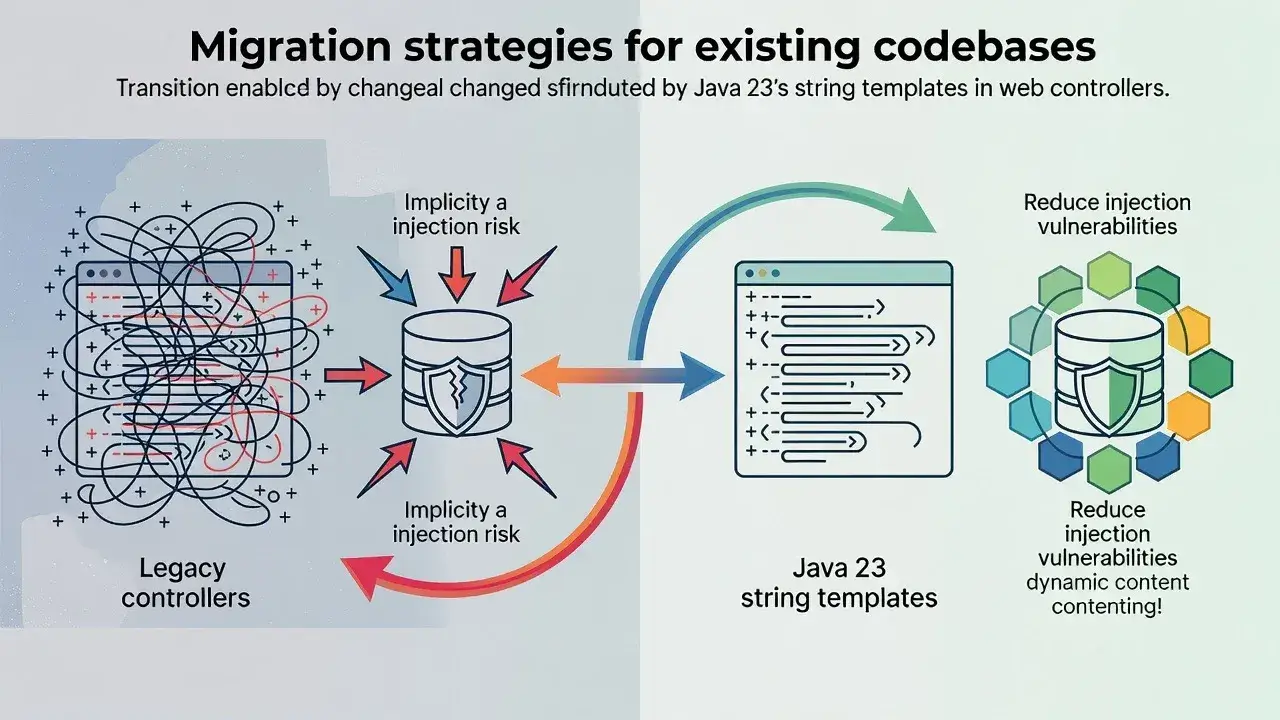
Adopting string templates doesn't require rewriting entire applications. Controllers can migrate incrementally, starting with the most complex or security-sensitive endpoints.
The feature works alongside existing string manipulation code without conflicts. Teams can establish patterns for new development while gradually refactoring legacy controllers as they receive updates.
Testing remains straightforward because templates produce standard String objects. Existing unit tests continue working without modification, allowing safe refactoring with confidence.
Framework integration and ecosystem support
Major Java web frameworks are already exploring string template integration. Spring MVC controllers can use templates in @ResponseBody methods, while Jakarta EE implementations support them in JAX-RS resources.
Template processors for common frameworks
Framework-specific processors handle content negotiation, response encoding, and header management automatically. Developers write templates that focus on business logic while the framework handles HTTP concerns.
This integration reduces the impedance mismatch between application code and framework requirements. Controllers become thinner and more focused on domain logic rather than HTTP mechanics.
Real-world adoption considerations
String templates remain a preview feature in Java 23, meaning syntax and behavior may change in future releases. Production adoption requires careful evaluation of stability requirements and update schedules.
Teams should experiment with templates in non-critical endpoints first, building familiarity with the feature before wider deployment. The preview status allows providing feedback to the Java community that shapes the final specification.
Documentation and tooling support continue improving as the feature matures. IDEs add syntax highlighting, refactoring tools, and inspection capabilities that make templates feel like first-class language citizens.
A new era for Java web development
String templates represent the most significant improvement to Java web controller development in years. By addressing longstanding pain points around string manipulation, security, and readability, this feature elevates the developer experience while improving application safety and performance. As the feature progresses toward finalization, teams should prepare migration strategies to capitalize on these benefits in their codebases.