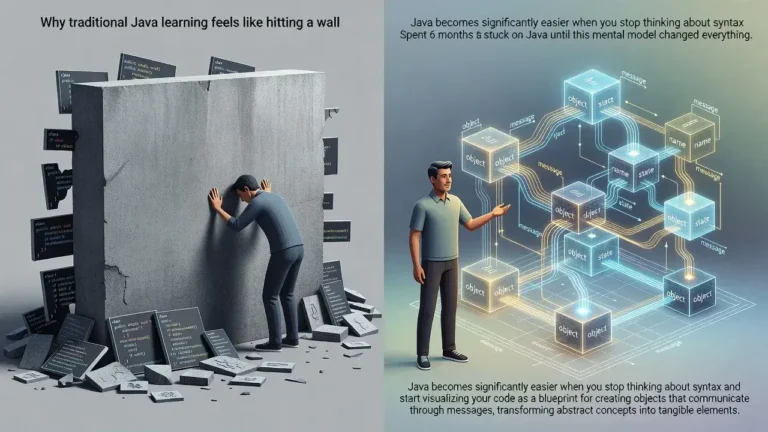
Most Java tutorials skip teaching object state management and lifecycle understanding, which is the critical concept that transforms objects from abstract theory into practical tools developers can confidently manipulate and design.
Most Java tutorials skip the one thing that makes objects finally make sense—the relationship between an object's state and its behavior over time. You've probably memorized syntax, created classes, and instantiated objects dozens of times. Yet something feels incomplete, like you're following recipes without understanding why ingredients combine the way they do.
Why traditional tutorials fall short
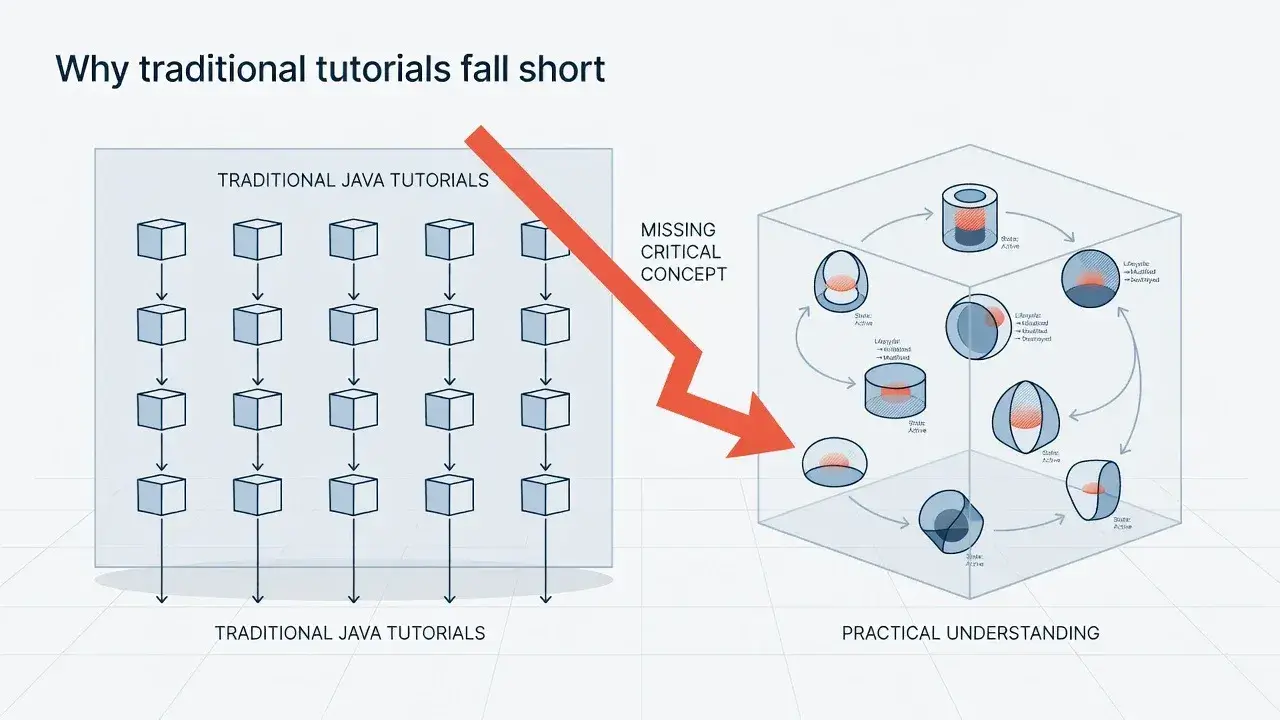
Standard Java courses focus heavily on syntax and mechanics. You learn about constructors, methods, and access modifiers. These elements matter, but they represent the "what" without addressing the "why" that makes everything coherent.
The missing element is understanding how objects maintain state throughout their existence. State isn't just variables sitting in memory—it's the living memory of an object that influences every decision it makes. When you grasp this connection, suddenly inheritance makes sense. Encapsulation stops feeling arbitrary. Polymorphism becomes intuitive rather than mysterious.
What object state really means in practice
Think of state as an object's current condition based on its history of interactions. A bank account object doesn't just hold a balance number—it carries the accumulated result of every deposit and withdrawal.
State components that tutorials overlook
- Mutable versus immutable state and when each approach serves you better
- How state changes trigger behavior modifications within the same object
- The relationship between constructor parameters and initial state setup
- State validation and maintaining object integrity across method calls
When you recognize that methods exist primarily to either query or modify state, object-oriented design transforms from abstract philosophy into practical problem-solving. Every method becomes a conversation with an object's current reality.
The lifecycle perspective that changes everything
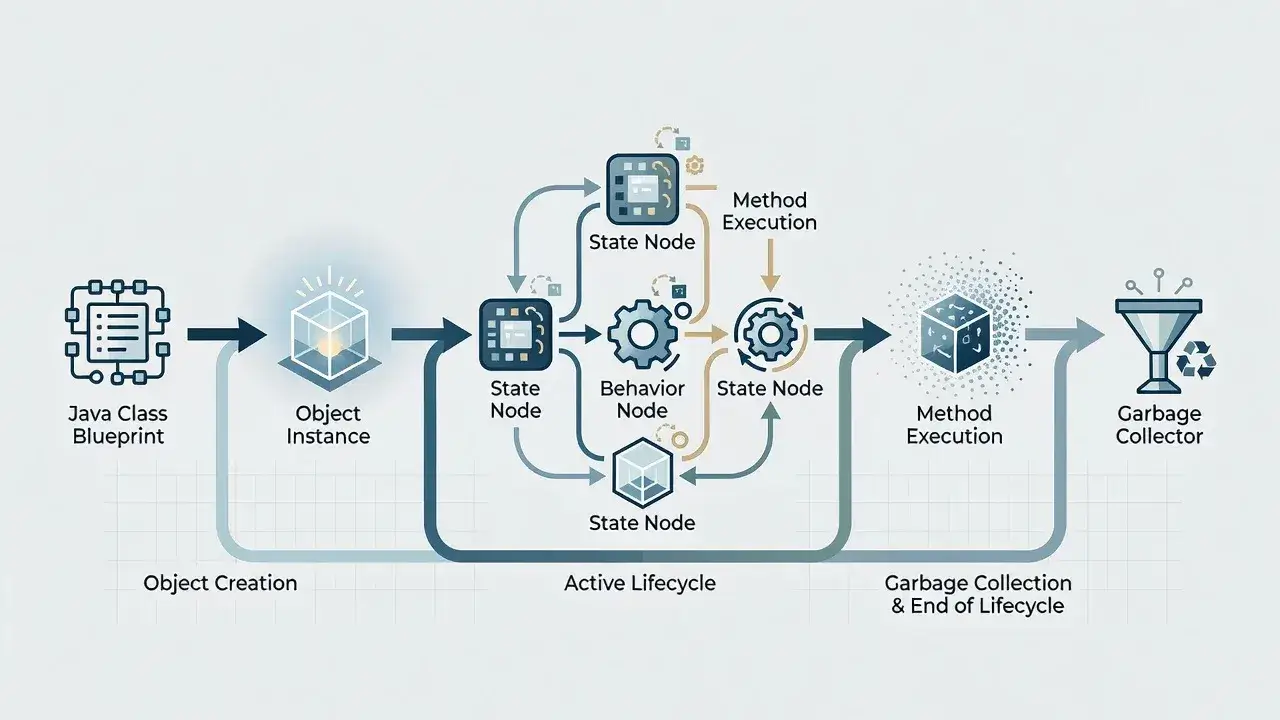
Objects aren't static blueprints—they're entities with lifecycles. They get created, modified, used, and eventually destroyed. Understanding this temporal dimension makes design patterns suddenly obvious.
Consider a shopping cart object. Its state evolves from empty to containing items to checked out. Each state permits different operations. An empty cart can't proceed to checkout. A checked-out cart shouldn't accept new items. This state-dependent behavior is what makes objects powerful modeling tools.
Lifecycle stages worth understanding
- Initialization phase where constructors establish valid starting states
- Active phase where methods modify state within defined rules
- Transition moments when state changes unlock or restrict capabilities
This perspective explains why immutability matters in certain contexts. Some objects benefit from state changes; others work better as snapshots of a moment in time. The choice depends on what you're modeling and how it behaves in the real world.
How state connects to encapsulation
Encapsulation isn't about hiding data for security theater. It's about protecting state integrity so objects remain valid throughout their lifecycle.
When you make fields private and expose public methods, you're creating controlled access points. These methods become guardians that prevent invalid state transitions. A person object shouldn't accept negative age values. A date object shouldn't represent February 30th.
This protective layer ensures that once created, an object can trust its own state. Methods can make assumptions about field values without constant validation. This trust is what makes complex systems manageable.
Why inheritance finally makes sense
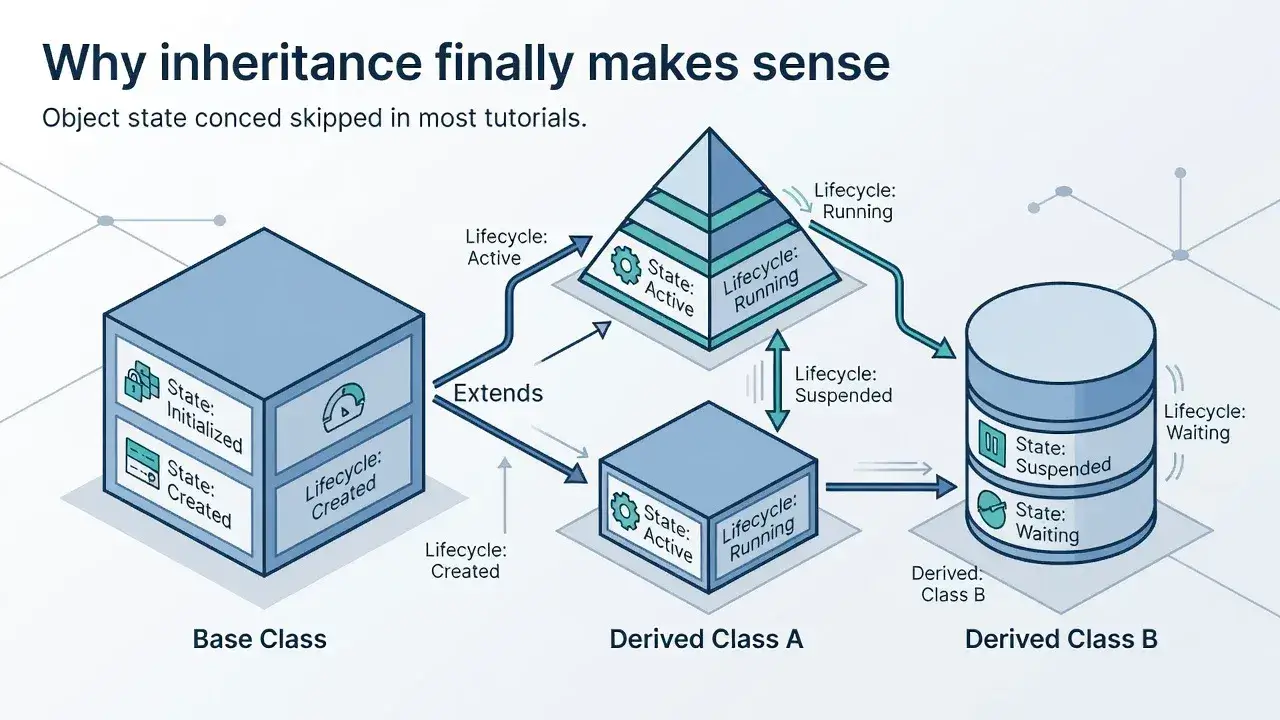
Inheritance becomes clear when viewed through state management. Subclasses inherit not just methods but state structure. They extend the parent's state with additional fields and behaviors.
A Vehicle class maintains speed and direction state. A Car subclass adds gear and fuel state. The car inherits vehicle movement behavior while adding transmission-specific operations. Both state layers coexist, with the subclass building upon the foundation.
This layered state approach explains why you call super constructors—you're ensuring the parent state initializes correctly before adding your specialized state on top.
Practical exercises that build intuition
Stop writing trivial getters and setters. Instead, create objects that model real-world entities with meaningful state transitions.
Recommended practice projects
- Build a traffic light object that cycles through states with timing rules
- Create a game character with health, experience, and level states that interact
- Design a document object that tracks draft, review, and published states
- Implement a reservation system where bookings transition through confirmation stages
These exercises force you to think about valid states, illegal transitions, and how methods enforce business rules through state management. You'll discover that good object design is mostly about modeling state correctly.
Moving beyond tutorial limitations
Once you internalize state management as the core concept, advanced topics become accessible. Concurrency issues are really about multiple threads modifying shared state. Design patterns are proven solutions for managing state complexity. Testing becomes easier when you think in terms of state verification.
The breakthrough moment arrives when you stop thinking about objects as code containers and start seeing them as state machines with behavior. This shift in perspective is what most tutorials never deliver, yet it's the foundation that makes everything else fall into place naturally.
The conceptual shift that matters
Understanding objects through their state and lifecycle transforms Java from a collection of syntax rules into a coherent modeling language. This perspective isn't just theoretical—it directly improves how you design classes, choose between patterns, and structure applications. When state management becomes your mental framework, object-oriented programming stops feeling arbitrary and starts feeling inevitable.