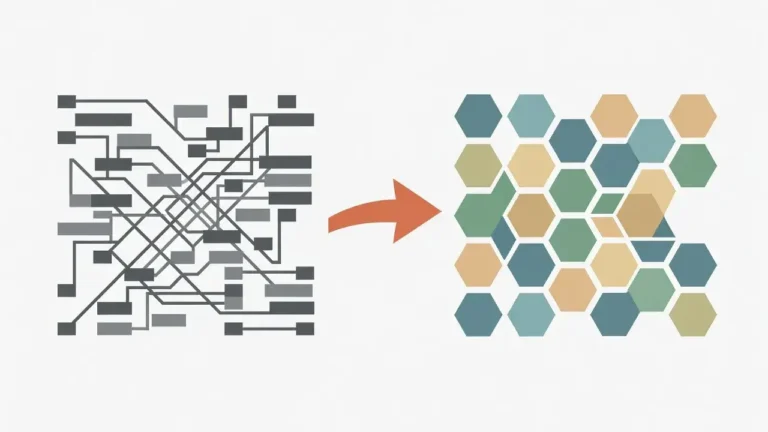
Java becomes significantly easier when you stop thinking about syntax and start visualizing your code as a blueprint for creating objects that communicate through messages, transforming abstract concepts into tangible mental images that make complex programming patterns intuitive.
Spent 6 months stuck on Java until this mental model changed everything for developers who felt overwhelmed by object-oriented programming. Many beginners struggle because they approach Java as just another set of rules to memorize, rather than understanding the underlying philosophy that makes everything click into place.
Why traditional Java learning feels like hitting a wall
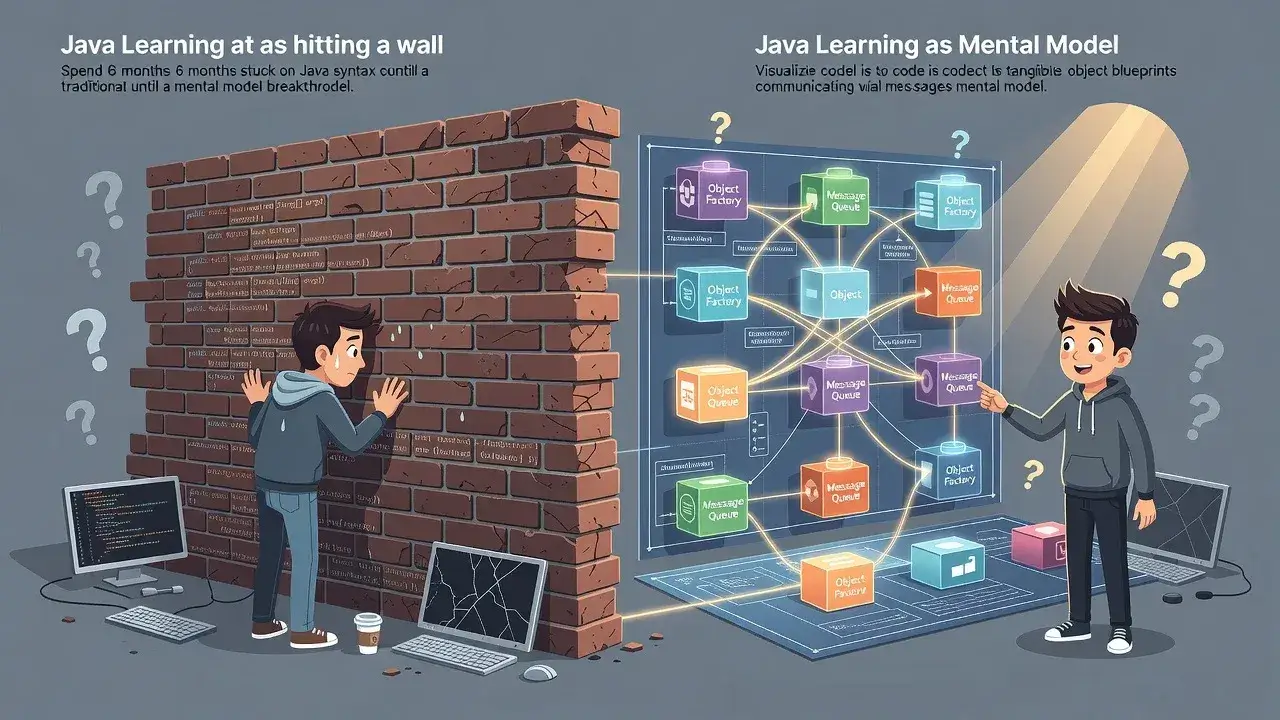
Most Java courses throw syntax at you without context. You learn about classes, methods, and inheritance, but these concepts remain abstract puzzles that don't connect.
The problem isn't your intelligence or dedication. Traditional teaching focuses on the "what" and "how" without addressing the "why" behind Java's design. When you can't see the bigger picture, every new concept feels like an isolated challenge rather than part of a coherent system.
This approach creates frustration because your brain naturally seeks patterns and connections. Without a unifying mental framework, you're essentially trying to memorize hundreds of disconnected facts, which is exhausting and ineffective for long-term retention.
The blueprint metaphor that transforms understanding
Think of Java classes as architectural blueprints rather than code templates. This single shift in perspective changes everything.
How the blueprint model works in practice
When you design a house, you create a blueprint that specifies rooms, doors, and windows. The blueprint itself isn't a house—it's a plan for building houses. Each house built from that blueprint is unique, with different paint colors, furniture, and occupants.
- Classes are your blueprints defining structure and capabilities
- Objects are the actual houses built from those blueprints
- Methods are the actions those houses can perform
- Attributes are the characteristics that make each house unique
This mental model eliminates confusion about why you need classes before creating objects. You wouldn't build a house without plans, and you can't create objects without class definitions.
Objects as living entities that communicate

The second crucial shift involves seeing objects as independent entities that send messages to each other, rather than passive data containers.
Imagine objects as people in an organization. Each person has responsibilities, knowledge, and the ability to communicate with others. When you call a method, you're essentially asking an object to perform a task it knows how to do.
Message passing versus function calling
This distinction seems subtle but profoundly impacts how you design programs. You're not commanding objects—you're requesting services from them.
- Objects maintain their own internal state privately
- They respond to requests through public methods
- Encapsulation protects data integrity automatically
When you internalize this model, concepts like encapsulation and information hiding become obvious rather than arbitrary rules someone invented to make programming harder.
Inheritance as specialized blueprints
Inheritance confused me until I visualized it as creating specialized versions of existing blueprints rather than copying code.
If you have a blueprint for a generic vehicle, you can create specialized blueprints for cars, trucks, and motorcycles. Each specialized blueprint inherits the basic vehicle structure but adds unique features. You're not duplicating the entire vehicle blueprint—you're extending it with specific modifications.
This perspective makes inheritance decisions clearer. You ask whether one thing truly is a specialized version of another, not whether you can reuse some code. The relationship must make logical sense in the real world, not just save typing.
Interfaces as contracts between objects
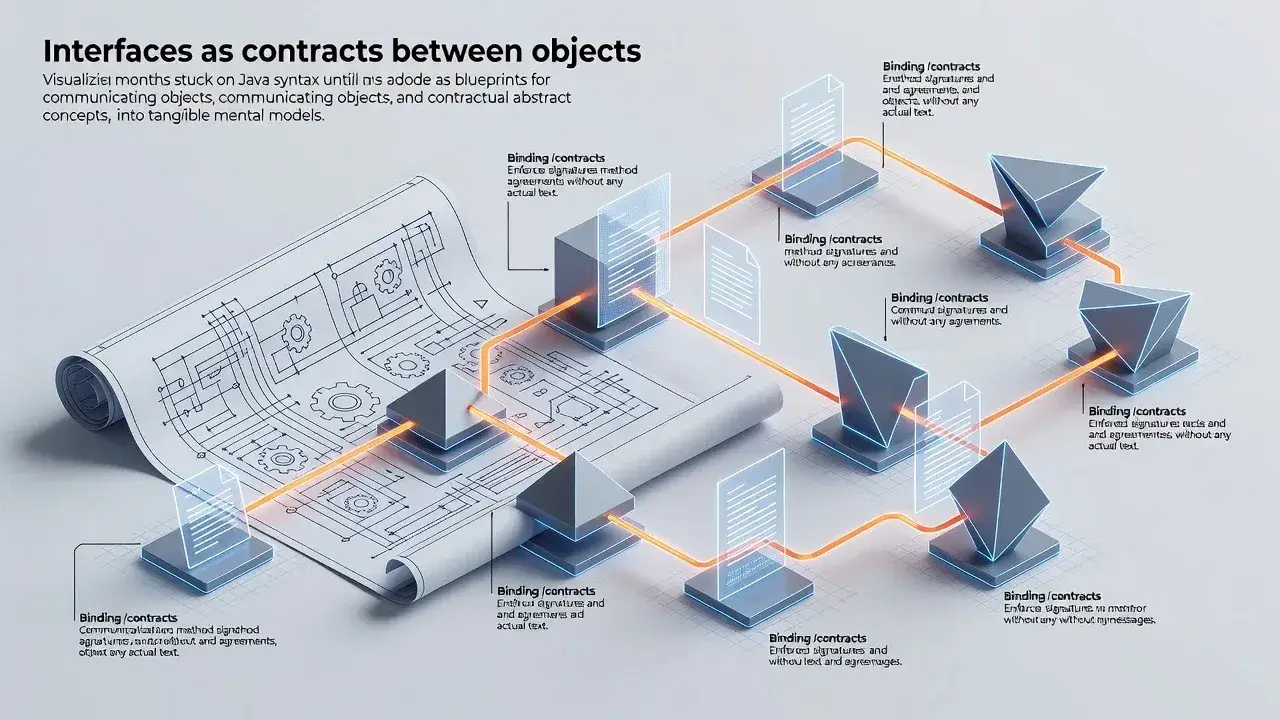
Interfaces became intuitive when I started seeing them as service contracts rather than abstract code requirements.
The contract metaphor in action
When you hire a contractor, you don't care about their internal processes. You care that they fulfill the contract—delivering specified services with agreed-upon results.
- Interfaces define what services an object promises to provide
- Implementation details remain hidden and flexible
- Multiple objects can fulfill the same contract differently
- Your code depends on contracts, not specific implementations
This mental model makes polymorphism natural. You write code that works with any object fulfilling a contract, without knowing or caring about the specific implementation behind that contract.
Exceptions as communication about problems
Exception handling stopped feeling arbitrary when I understood exceptions as a specialized communication channel for reporting problems.
Objects encounter situations they can't handle alone. Rather than failing silently or returning cryptic error codes, they throw exceptions—clear messages describing what went wrong and why. Your code can catch these messages and respond appropriately, or let them bubble up to someone better equipped to handle them.
This framework transforms exception handling from defensive programming into thoughtful communication design. You consider which problems an object should handle internally and which require external intervention.
Collections as specialized containers with behaviors
Java's collection framework makes sense when you stop seeing collections as simple data storage and recognize them as specialized containers with distinct behaviors optimized for different scenarios.
A List maintains order and allows duplicates, like a queue of people waiting. A Set eliminates duplicates, like a guest list where each name appears once. A Map connects keys to values, like a phone directory linking names to numbers.
Choosing collections by behavior needs
You select collections based on what you need to do with data, not arbitrary preferences. Do you need fast lookups? Maintained order? Unique elements? Each collection type excels at specific operations.
This behavioral perspective helps you write more efficient code naturally, because you're matching data structures to actual requirements rather than using ArrayList for everything because it's familiar.
Thinking in objects changes everything
The mental models described here transformed six months of frustration into genuine understanding. Java stopped being a collection of confusing rules and became a logical system for organizing complex programs. When you visualize classes as blueprints, objects as communicating entities, and interfaces as contracts, the entire language becomes intuitive. These frameworks don't just help you understand Java—they change how you approach problem-solving in programming, making you a more effective developer across any object-oriented language.