
Pattern matching in Java's switch expressions eliminates verbose conditional logic by allowing developers to match types, deconstruct objects, and apply guard conditions directly within switch statements, transforming complex if-else chains into concise, readable code blocks.
The hidden Java feature that replaced 90% of my if-else chains isn't some obscure library or framework—it's pattern matching with switch expressions, introduced progressively from Java 14 onwards. This capability fundamentally changes how we handle conditional logic, making code cleaner and more maintainable. If you've been writing nested if-else statements for years, this feature will feel like discovering a secret weapon that was hiding in plain sight.
What makes pattern matching different from traditional switches

Traditional switch statements in Java were limited to primitive types and strings, forcing developers into lengthy if-else chains whenever dealing with objects or complex conditions. Pattern matching breaks these limitations entirely.
The new approach allows you to match against types, extract values, and apply conditions all within the switch construct. Instead of checking instanceof repeatedly and casting objects manually, you declare the type directly in the case label. The compiler handles type checking and casting automatically, reducing boilerplate and potential errors.
This transformation means code that once spanned 20-30 lines can shrink to 5-8 lines while becoming more readable. The switch expression also returns values directly, eliminating the need for temporary variables and break statements that cluttered older implementations.
Type patterns: eliminating instanceof checks
Type patterns represent the most immediate benefit of this feature, replacing the classic instanceof-cast pattern that Java developers have written countless times.
How type patterns work in practice
When you write a case with a type pattern, Java automatically checks if the object matches that type and binds it to a pattern variable. This variable is already cast and ready to use within that case block.
- No manual casting required after instanceof checks
- Pattern variables are scoped only to their case block
- Compiler ensures type safety throughout the expression
- Code becomes self-documenting through explicit type declarations
The result is code that reads almost like natural language, where each case clearly states what type it expects and what operations it performs on that type.
Guard conditions: adding logic without nesting
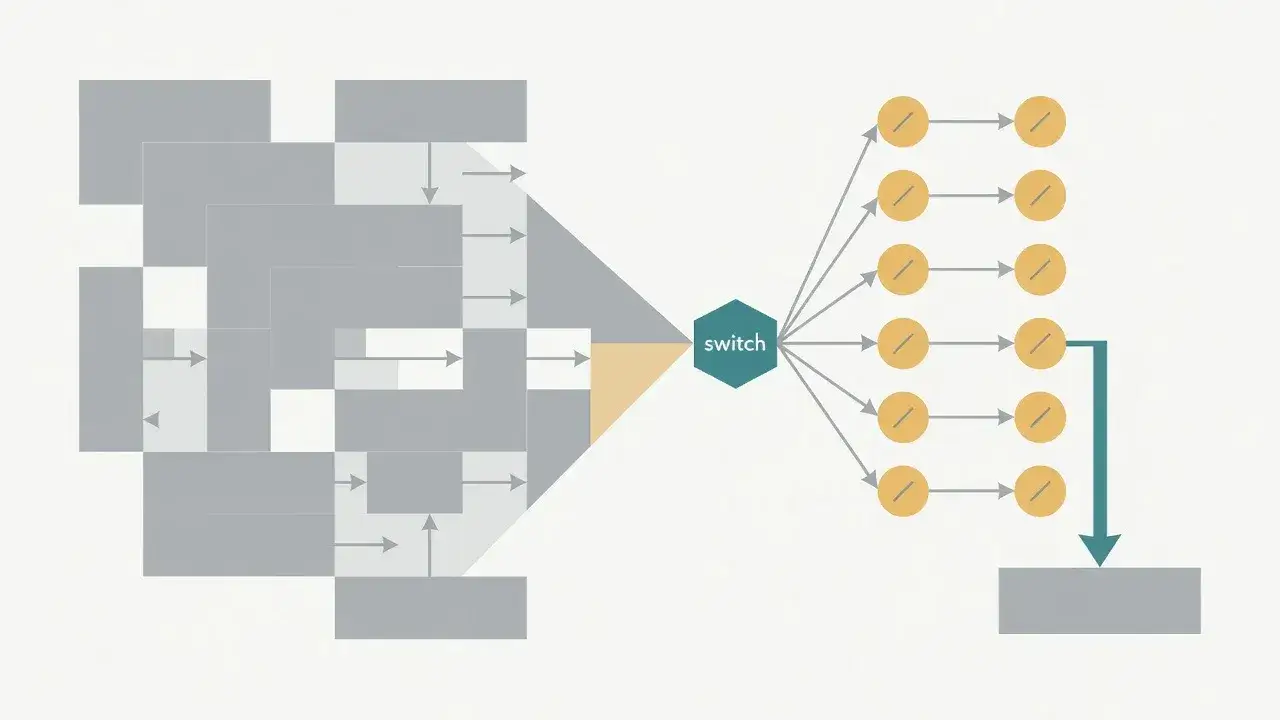
Guard conditions take pattern matching further by allowing you to specify additional requirements beyond type matching, all within the case label itself.
Using the when keyword, you can add boolean expressions that must be true for a case to match. This eliminates nested if statements inside case blocks, keeping your logic flat and readable. For example, you might match a String type but only when its length exceeds a certain value, or match an Integer when it falls within a specific range.
Practical applications of guards
- Validating object states before processing
- Filtering based on property values without additional conditionals
- Combining multiple conditions that previously required separate if statements
Guards maintain the declarative style of pattern matching while handling complex business logic that would otherwise force you back into imperative if-else structures.
Record patterns: deconstructing data in one step
Record patterns extend pattern matching to Java records, allowing you to extract component values directly in the case label through deconstruction.
When matching against a record type, you can specify patterns for each component, binding them to variables immediately. This means you can match a Point record and extract its x and y coordinates in a single expression, rather than first matching the type and then calling accessor methods.
The deconstruction syntax mirrors the record constructor, making it intuitive to read and write. You can even nest patterns, deconstructing records that contain other records in one elegant expression. This capability transforms how we work with data-carrying objects, making data extraction and validation simultaneous operations.
Real-world impact: before and after comparisons

The true value of pattern matching becomes clear when comparing actual code transformations in production scenarios.
Processing polymorphic collections
Before pattern matching, processing a list of mixed types required checking each object's type, casting it, and then performing operations. This resulted in deeply nested if-else chains that were difficult to read and maintain.
With pattern matching, each case handles a specific type with its operations clearly defined. The code becomes a simple list of possibilities rather than a nested maze of conditionals. Error handling improves because exhaustiveness checking can warn you if you haven't covered all types.
This transformation doesn't just reduce line count—it fundamentally improves code comprehension and reduces cognitive load when reading or modifying the logic months later.
Migration strategies: updating existing codebases
Adopting pattern matching in existing projects requires a thoughtful approach rather than wholesale rewrites.
Start by identifying if-else chains that check types or object properties repeatedly. These are prime candidates for conversion. Focus on code that handles polymorphic types or processes different data shapes based on runtime information.
- Begin with isolated utility methods that have clear inputs and outputs
- Convert visitor patterns that have grown unwieldy over time
- Target validation logic that checks multiple object states
- Refactor command processors that dispatch based on message types
Each conversion should maintain existing behavior while improving readability. Write tests before refactoring to ensure behavioral equivalence, and introduce the changes gradually through your codebase rather than attempting massive refactorings.
Performance considerations and compiler optimizations
Pattern matching isn't just about cleaner code—the compiler can optimize switch expressions more effectively than traditional if-else chains.
Modern JVMs can generate jump tables or binary search trees for switch statements, providing constant or logarithmic time complexity instead of linear checks. Pattern matching preserves these optimizations while adding type checking capabilities. The compiler also eliminates redundant type checks when it can prove that certain cases are unreachable.
In practice, pattern matching performs comparably to hand-written if-else chains in most scenarios, while offering better performance in cases where the compiler can apply advanced optimizations. The real performance gain comes from reduced bugs and faster development cycles rather than raw execution speed.
Embracing declarative conditional logic
Pattern matching with switch expressions represents a fundamental shift in how Java developers write conditional logic, moving from imperative checking and casting to declarative type matching and deconstruction. This feature eliminates the verbose if-else chains that have characterized Java code for decades, replacing them with concise, readable expressions that clearly communicate intent. As this feature matures and becomes standard practice, it will define modern Java development, making code more maintainable and reducing the cognitive burden of understanding complex conditional logic.